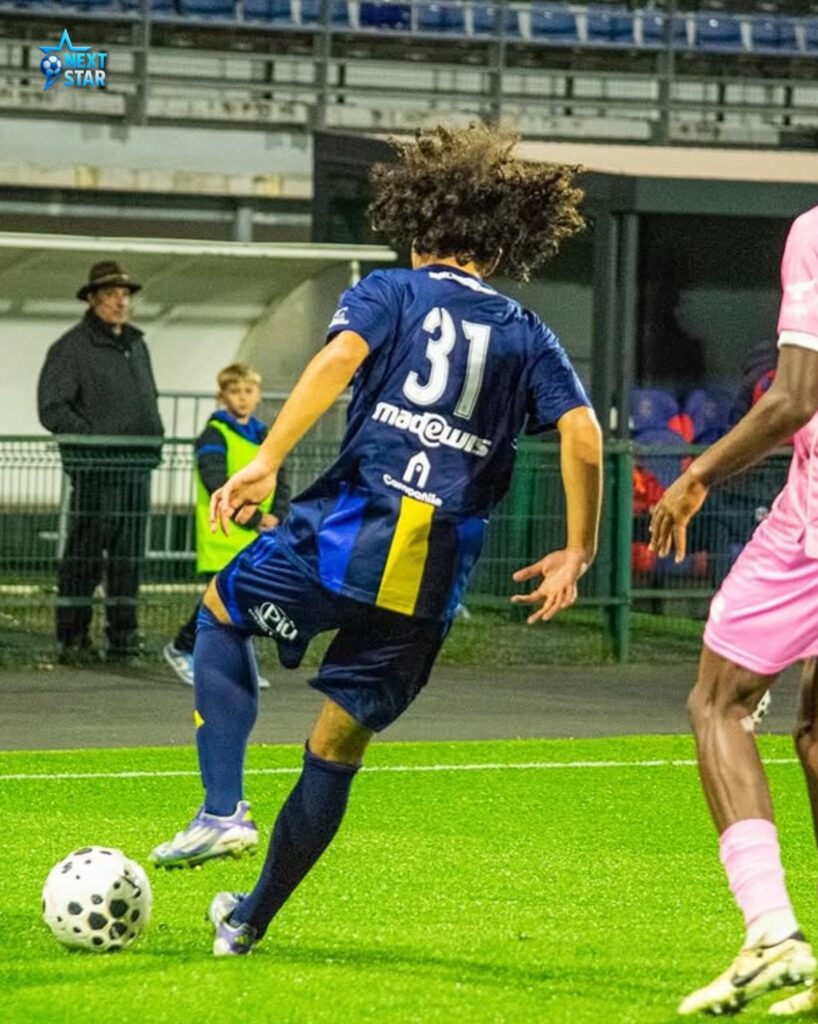

Youth football is often defined by physical dominance or early athletic development. However, every generation also produces profiles whose influence is built primarily on technical intelligence, spatial awareness, and refined ball control. Mahdi Maghlout belongs to this second category.
Born on 03 May 2009, the French-Algerian attacking midfielder recently took an important step in his development by joining Inter in January, signing a contract until the summer of 2028. Now part of Inter U17, Maghlout is beginning to integrate into one of Europe’s most structured youth development systems.
After two early appearances with strong performances, early indicators suggest that Inter may have secured a technically advanced, creative profile capable of influencing matches between the lines.
This report evaluates his profile from a technical, tactical, physical, and developmental perspective.
Background & Context
At 16 years of age, Maghlout represents the modern attacking hybrid: capable of operating centrally as a traditional number 10, but equally comfortable drifting wide on the right side to attack inside onto his stronger left foot.
The decision to join Inter is significant. The club’s academy structure emphasizes tactical discipline, positional education, and technical refinement, factors that are essential for players whose game relies more on intelligence and execution rather than pure athletic superiority.
His contract running until 2028 suggests long-term belief in his development pathway.
So far, his integration phase has been positive. In his first two matches with Inter U17, he has shown composure and adaptability, avoiding the common transitional hesitation many players experience after joining a new environment.
Technical Profile – Ball Mastery & Creativity
Maghlout’s standout quality is technical execution under pressure.
When receiving the ball between lines, his first touch is consistently oriented forward. Instead of controlling and resetting, he frequently uses his first contact to eliminate an opponent or open an attacking lane. This detail separates reactive youth players from proactive ones.
In 1v1 situations:
- He attacks defenders rather than recycling possession.
- He uses quick directional changes rather than excessive step-overs.
- His close control allows him to manipulate tight spaces.
His left foot is clean and controlled. When cutting inside from the right flank, he naturally positions his body to threaten both shot and through-pass options. This dual threat forces defenders to hesitate — and hesitation creates space.
Beyond dribbling, his passing vision deserves attention.
He shows comfort playing vertical passes between defensive lines. These are not hopeful forward balls but measured, timed penetrative passes aimed at breaking compact blocks. His head-up scanning before receiving the ball allows him to identify interior movements early.
He is capable of:
- Delivering final-third through balls
- Combining quickly in tight triangles
- Switching play when space collapses
For a 16-year-old, the composure in decision-making is encouraging.
Positional Intelligence & Off-Ball Movement
One of the most difficult qualities to teach in youth development is spatial awareness. Maghlout demonstrates early signs of understanding how to occupy space rather than chase the ball.
When deployed centrally:
- He positions himself between midfield and the defensive lines.
- He drifts laterally to avoid direct marking.
- He times his movements to receive on the half-turn.
When used on the right:
- He stretches wide to create isolation situations.
- He cuts inside at moments when the full-back is unbalanced.
- He rotates positions fluidly with teammates.
This positional unpredictability makes him difficult to track. Rather than staying static, he constantly adjusts his body orientation to remain available as a progressive option.
In structured academies like Inter’s, tactical intelligence is refined through repetition. His current understanding suggests strong developmental foundations.
Decision-Making in the Final Third
Young attacking players often struggle with over-dribbling or forcing low-percentage shots. Maghlout’s early appearances show a more balanced approach.
In scoring zones:
- He is capable of finishing when space opens centrally.
- He looks for combination plays rather than isolated hero plays.
- He demonstrates patience in the build-up phases.
While still developing consistency, his willingness to combine instead of forcing individual solutions reflects maturity.
This balance between creativity and responsibility is crucial for long-term growth.
Physical Development & Athletic Projection
At 16, physical development remains ongoing. Currently, areas for improvement include:
- Upper-body strength
- Duel resistance in shoulder-to-shoulder battles
- Sustained stamina over extended high-intensity phases
However, these are typical for players of his age group, particularly those who rely on technical ability rather than early physical dominance.
The key question is not current physical power, but projection. Within a structured performance environment like Inter’s, physical conditioning programs are individualized. With proper development, improved explosiveness and endurance can significantly elevate his impact.
Importantly, his technical game does not rely solely on pace. This reduces long-term risk if physical growth progresses gradually.
Mental Attributes & Adaptation
Transitioning to a major academy can challenge young players mentally. Early signs suggest Maghlout has adapted positively.
He has:
- Shown confidence in demanding possession
- Avoided hiding during difficult phases
- Maintained composure under pressure
Confidence without recklessness is a valuable balance. He does not appear intimidated by tempo shifts, which is promising for future progression into higher age categories.
Development Environment – Why Inter Matters
Inter’s youth structure is widely respected for its tactical education and long-term player management.
For Maghlout, this environment offers:
- Structured positional coaching
- Exposure to high-intensity youth competition
- Tactical discipline alongside creative freedom
His upcoming away match against Atalanta U17 will provide a stronger indicator of consistency. Away fixtures often test mental resilience and adaptability more than home matches.
Consistency across multiple high-intensity matches will be the next stage.
Long-Term Projection
Maghlout profiles as a creative left-footed attacker capable of operating as:
- A central attacking midfielder in a 4-2-3-1
- An inverted right winger in a 4-3-3
- A hybrid interior playmaker in possession-based systems
His long-term ceiling will depend on:
- Physical progression
- Tactical refinement
- Decision-making speed under higher pressure
If these elements develop steadily, he has the foundational tools to transition into higher youth categories with impact.
Final Evaluation
Mahdi Maghlout is a technically refined, tactically aware, and creatively oriented attacking prospect currently developing within Inter’s U17 structure.
His ability to:
- Break lines with passing
- Eliminate defenders in tight areas
- Occupy intelligent positions between blocks
- Combine creativity with composure
makes him an interesting profile to monitor.
While physical development remains ongoing, his technical base and spatial intelligence provide a solid foundation for progression.
The next phase of his growth will be defined by consistency and adaptation to increasing competitive demands.
For now, his trajectory within Inter’s academy structure places him on a promising developmental pathway.